Fire Watch During Impairment
Continuous cover while fire alarms, detection or sprinklers are out of service, so the building is not left without a means of detecting fire.
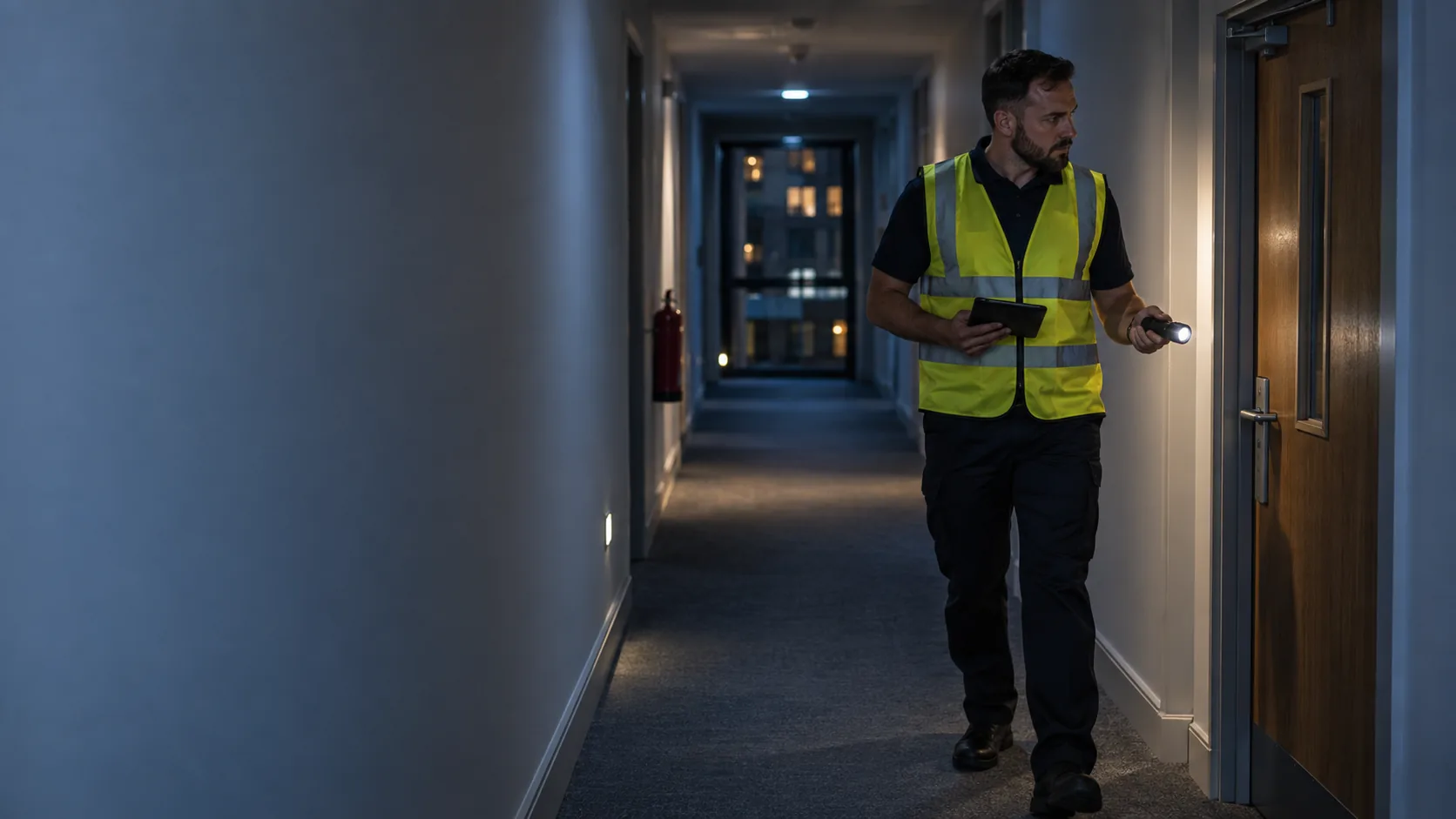
AGS Security provides trained fire marshals and fire watch personnel for commercial premises, construction sites and vacant buildings across the UK — most often where fire detection or suppression systems are temporarily out of service.
When an alarm system, sprinkler or detection is impaired, the building does not stop being occupied and the risk does not pause. A fire watch replaces the missing system with people: trained personnel patrolling agreed routes, watching for signs of fire, and raising the alarm the moment something is found.
Our marshals are trained to Level 2 Award in Fire Safety Principles or equivalent fire marshal certification, and where you need a fire risk assessment we can arrange one through a competent assessor.
What personnel watch for, how often they patrol, what they check and who they call are agreed for your building and written down before the first shift.

Continuous cover while fire alarms, detection or sprinklers are out of service, so the building is not left without a means of detecting fire.
Empty buildings where systems are off and arson or accidental ignition is the principal risk, checked on an agreed pattern.
Set routes covering plant rooms, risk areas, voids and floors at the frequency agreed for the building and its occupancy.
Exits, corridors and final doors checked to confirm they are clear, unobstructed and usable rather than propped or blocked.
Visual checks that extinguishers, call points and signage are present, visible and unobstructed. Servicing stays with your fire equipment contractor.
Ignition sources, accumulated waste, blocked routes and unsafe storage identified and reported before they become an incident.
A written procedure for raising the alarm, calling the fire service and notifying your responsible person without delay.
Where you need an assessment, AGS can arrange one through a competent assessor, separately from the fire watch itself.
A fire watch is bought under pressure. A system fails, an insurer or inspector asks what cover is in place, and someone needs personnel on site tonight. That urgency is exactly why the detail gets skipped.
We would rather agree the patrol routes, the frequency and the escalation procedure before anyone starts, and give you a written log afterwards, so what you bought is provable rather than assumed.
Level 2 Award in Fire Safety Principles or equivalent fire marshal certification, not an afternoon briefing.
Systems fail without warning. We are set up to place personnel quickly when an impairment starts unexpectedly.
A fire watch log showing patrol times and observations, which is what an insurer or inspector will actually ask to see.
We tell you plainly what marshals do and do not do, rather than letting you assume cover you have not bought.
Fire cover considered alongside officers, patrols and vacant property protection, from one provider.
Priced on the building, the hours and the watch frequency agreed, rather than a standard package.
An impaired system means nothing is watching for fire. Personnel on agreed patrol routes restore that until the system returns.
Where cover is a condition of continuing to occupy or work in a building, having it in place keeps the programme moving.
A written fire watch log evidences the cover that was in place, at what times, and what was found.
The value of a watch is the interval. A fire found within minutes is a different event from one found in the morning.
Blocked exits, accumulated waste and unsafe storage reported as they appear rather than discovered during an inspection.
Overnight watch duty pulled onto managers and site staff is unsustainable within days. Trained personnel do it properly.
Fire watch is usually triggered by one of two situations. It is worth being equally clear about where AGS's part ends, because that is where most suppliers are vague.
A fire alarm, detection system or sprinkler installation is impaired — through failure, planned works, refurbishment or an upgrade. The building is still in use, so the detection the system provided has to come from somewhere. Trained personnel on agreed patrol routes provide it until the system is signed back into service.
Empty property is a distinct fire risk: systems switched off, nobody present, and arson a recognised threat to buildings awaiting demolition, sale or refurbishment. Fire watch checks are often required alongside the security patrols an insurer already expects on a void building.
Under fire safety law the duty sits with your organisation's responsible person, and engaging a fire watch does not transfer it. AGS supplies trained personnel, patrols and records, and can arrange a fire risk assessment through a competent assessor. We do not service fire equipment or sign systems back into service.
Waking watch is the term used when an occupied residential building needs continuous on-site fire cover, usually while a fire safety defect is being put right. The discipline is the same as a fire watch. What changes is that people are living in the building, the cover runs to that building’s own evacuation strategy, and it is instructed by the responsible person rather than a site manager.
Continuous patrols of floors, corridors, stairwells and external areas on an agreed route and frequency. Escape routes, fire doors and communal areas are checked on every circuit. Where a fire is found, the priority is always alerting occupants and the fire service and initiating the evacuation plan set for that building. Every patrol is logged, and the record is available to the responsible person.
A waking watch is normally introduced where a residential building is operating under a simultaneous evacuation strategy because a fire safety defect has been identified, and it is usually held in place as an interim measure until a common alarm system is installed or the defect is resolved. The instruction typically comes from the freeholder, the managing agent or the building’s responsible person.
AGS has provided waking watch cover on four residential buildings in Birmingham, delivered by AGS officers under a subcontract. Before cover begins, teams are briefed on that specific building, roles are defined and written assignment instructions issued, and checks are recorded against a fire safety checklist covering building protocols, reporting, response to a fire situation and escalation. AGS does not set the building’s fire strategy, and the duties of the responsible person under the Fire Safety Order stay exactly where they are.

Impairments rarely announce themselves in advance, so this is built to move quickly without skipping what matters.
What is impaired, which areas are affected, how the building is occupied, and how long cover is expected to be needed.
Patrol routes, watch frequency, check points, escalation contacts and reporting written into the assignment instructions.
Trained marshals briefed on your building and the specific impairment, then deployed for the hours agreed.
Written fire watch logs throughout, and cover stood down once the system is back in service and you confirm it.
Any building with a fire system has a day when that system is out of service. These are the sectors where it happens most.
Multi-occupancy buildings where an impaired system affects every tenant and cover cannot wait for the next working day.
View Commercial PropertySchools and public premises where systems are commonly upgraded during holidays while the building is still accessed.
View Education & Public BuildingsLarge-volume buildings where sprinkler impairment is a serious matter and insurers respond quickly to it.
View Warehousing & LogisticsEmpty buildings with systems switched off, where arson is a recognised and insurable risk.
View Unoccupied PropertyExplore selected AGS Security regions below or view the complete regional coverage network.
Fire marshal and fire watch cover across Wolverhampton, Birmingham and surrounding commercial premises.
Explore West MidlandsFire watch personnel for commercial and development locations across the South Midlands.
Explore South MidlandsImpairment cover across established East Midlands commercial and industrial premises.
Explore East MidlandsSupporting commercial, refurbishment and vacant building fire watch requirements across the capital.
Explore LondonFire watch cover for developments and operational premises across the South East.
Explore South EastFire marshal capability supporting commercial requirements across the North West.
Explore North WestThe schemes and bodies AGS Security is accredited by, registered with or a member of. If your procurement process needs certificates or scheme numbers, ask and we will send them across.






Fire watch is a service where the difference between what was specified and what was delivered may go unnoticed until an incident occurs. The quality of the cover matters most at the point it is tested.
Read feedback from organisations and clients that have worked with AGS Security across commercial, construction and operational environments.
Tell us the building, what is out of service and the hours you need covering, and we can confirm what cover we can put in place and when.